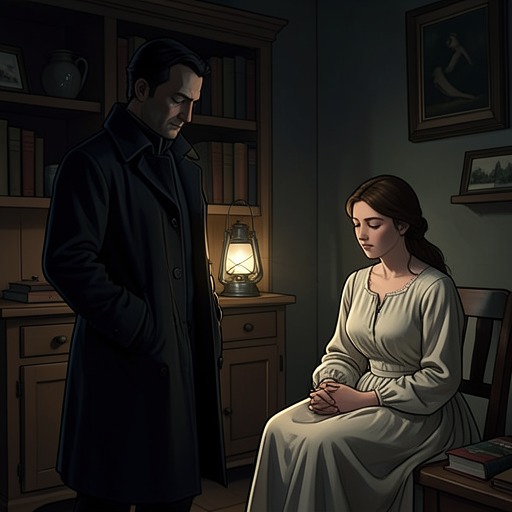
Jemima
When You Were MineJemima is the woman Peter Davenport loved and still hopes to find. A servant in the household of Dominic Cavendish’s uncle, she entered Peter’s life in circumstances involving danger and a secret connected to his past. Peter recalls that she left before he could ask her to marry him, and that he failed her when she needed help. Her whereabouts and present circumstances remain unknown in the account, but his refusal to relinquish his affection for her leads Isobel to take up the search on his behalf.
Identity and Circumstances
Jemima is introduced through Peter’s recollection rather than through a scene of her own. When Isobel asks why her brother has never married, Peter first offers her name, then remembers her appearance: dark blonde hair and amber eyes. The memory is emotionally difficult for him. Sadness crosses his face, he drinks from his goblet, and, as he continues, his expression turns bleak. These details establish that Jemima is not a casual or forgotten attachment; her absence remains closely bound to Peter’s grief.
Peter identifies Jemima as a servant in the house of Dominic Cavendish’s uncle, while clarifying that she did not come from a background of service. He also makes clear that she was not a lady of quality, a distinction Isobel recognizes as socially consequential: she initially reacts with surprise that Peter would choose a servant over the fashionable women who had made themselves available to him. The exchange places Jemima at a distance from the rank and expectations surrounding Peter’s social world, without suggesting that her status diminished his love for her.
Her History with Peter
The circumstances of their relationship are deliberately left incomplete. Jemima was in trouble and needed Peter’s help; she entrusted him with a secret connected to his past, and he agreed to assist her. Peter says that danger surrounded her, and that they fell in love, though he qualifies this by saying he loved her and only thought she might have feelings for him. The difference matters: his attachment is certain, but her feelings are not established with the same confidence, and her own account is not available.
Peter describes his conduct as a terrible mistake and says that he failed Jemima when she needed him. The narrative does not disclose the precise nature of that failure or the secret she revealed, so the cause of their separation remains a gap rather than a solved episode. What it does disclose is the consequence: Jemima left before Peter could make his marriage proposal. He had intended to ask her to marry him, but did not act before she was gone. His regret is thus attached both to a lost opportunity and to his belief that he let her down in a moment of need.
An Unfinished Search
Peter says Jemima came from Cornwall and was living in Derbyshire when he knew her. Her proximity to the area helps explain why he does not mind spending time there: alongside visiting Isobel and Dominic, he can make inquiries about Jemima himself. He has not found her. The search is active enough to shape where he spends time, but its progress has brought him no reunion and no reliable news of her present life.
The possibility that Jemima may have married someone else weighs on Peter. He raises that fear himself, imagining that she could already be another person’s wife. Isobel refuses to treat the possibility as a reason to stop looking; she says they will face it if it proves true and insists they will uncover Jemima’s whereabouts. Her confidence does not establish Jemima’s feelings or outcome. It instead gives Peter’s private, unsuccessful inquiries a shared purpose: Isobel offers to continue the chase when she returns to Willowbrook Hall and to use whatever information he has already gathered.
Significance and Unresolved Outcome
Peter’s account makes Jemima the measure of his resistance to a marriage without love. He says he may eventually have to marry and establish a family, but cannot bear the prospect of marrying a woman he does not love, nor bring himself to close off his affections for Jemima. His continued attachment is not presented as a completed romance: Jemima is absent, her feelings remain uncertain, and the search has not located her. The possibility of marriage depends on finding her and learning what became of her.
Isobel’s response turns Peter’s memory into a commitment between siblings. She argues that Jemima should not have to remain in service if she could be beside Peter, making him happy, and assures him that her status as a servant is no reason to deny either of them a chance. Her compassion is informed by her own experience of desperation and deprivation: she remembers that, without Dominic’s help, she might have remained on the streets and died from cold and hunger. That history helps explain why she treats Jemima’s possible circumstances as urgent rather than merely romantic. For now, Jemima occupies a carefully unresolved place in the story: loved by Peter, sought by him and Isobel, but not yet found.